
Is it Ethical To Deny Life-Extending Treatment for Chronic Disease Patients with Low Quality of Life?
Introduction
Denying life-extending treatment for patients with chronic disease who have a low quality of life is a difficult ethical dilemma. You may be thinking, “Wait, isn’t Medical Assistance in Dying (MAID) already legal?” That’s true, but MAID specifically refers to intentionally ending a person’s life to relieve suffering, with their consent. What we are discussing here is distinct: it is the decision to discontinue treatments that may be futile, meaning they no longer help or might cause even more harm. The heart of this debate lies between two ideas: respecting patients’ personal choices (autonomy) and doing what is best for their health and well-being (beneficence). To understand this dilemma, we need to discuss a tricky concept doctors often face – what counts as “futile” care in the first place?
Whose Decision Matters Most?
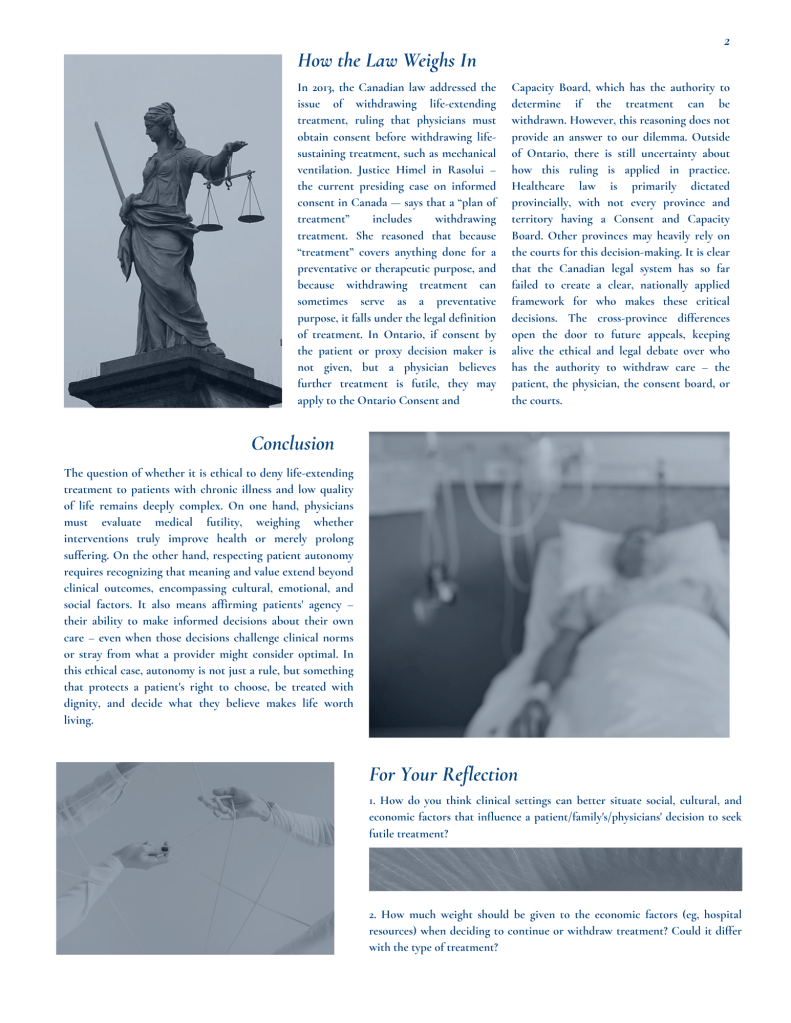
Respecting patient autonomy means honoring a person’s ability to make decisions based on their own values, beliefs, and lived experiences. In the context of life-extending treatment for chronic disease patients with low quality of life, autonomy emphasizes that patients are not just passive recipients of care but are active decision-makers. This principle goes beyond the idea of beneficence. While beneficence leaves room to prioritize health and reduce suffering, autonomy ensures that patients’ psychological well being is accounted for, even if their choices do not align with what a physician would deem as medically “best”. For example, Canadian law requires that treatment decisions must involve informed consent. This consent can be implied, oral, or written, but must always be informed, meaning patients must be provided with sufficient information about potential risks, benefits, and alternatives in order to make a choice based on their own beliefs and values. Ultimately, respecting these choices acknowledges agency – the capacity to make intentional, informed decisions and act on them in ways that reflect one’s identity. Recognizing this agency not only prevents harm but also reinforces the idea that patients are the true decision-makers in their own lives. So, whether they chose to take on or decline treatment, their decision deserves to be taken seriously.
When Medicine Meets Its Limits
Medical futility is a nuanced concept that does not lend itself to clear-
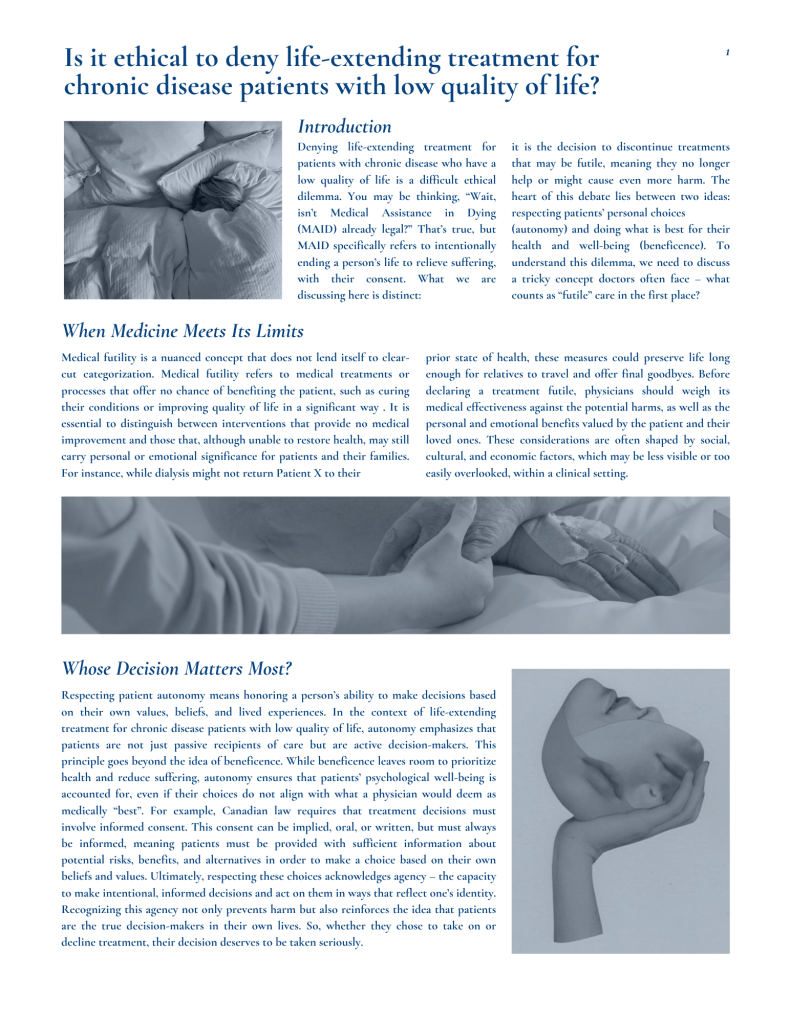
cut categorization. Medical futility refers to medical treatments or processes that offer no chance of benefiting the patient, such as curing their conditions or improving quality of life in a significant way . It is essential to distinguish between interventions that provide no medical improvement and those that, although unable to restore health, may still carry personal or emotional significance for patients and their families. For instance, while dialysis might not return Patient X to their prior state of health, these measures could preserve life long enough for relatives to travel and offer final goodbyes. Before declaring a treatment futile, physicians should weigh its medical effectiveness against the potential harms, as well as the personal and emotional benefits valued by the patient and their loved ones. These considerations are often shaped by social, cultural, and economic factors, which may be less visible or too easily overlooked, within a clinical setting.
How the Law Weighs In
In 2013, the Canadian law addressed the issue of withdrawing life-extending
treatment, ruling that physicians must obtain consent before withdrawing life- sustaining treatment, such as mechanical ventilation. Justice Himel in Rasolui — the current presiding case on informed consent in Canada — says that a “plan of treatment” includes withdrawing treatment. She reasoned that because “treatment” covers anything done for a preventative or therapeutic purpose, and because withdrawing treatment can sometimes serve as a preventative purpose, it falls under the legal definition of treatment. In Ontario, if consent by the patient or proxy decision maker is not given, but a physician believes further treatment is futile, they may apply to the Ontario Consent and Capacity Board, which has the authority to determine if the treatment can be withdrawn. However, this reasoning does not provide an answer to our dilemma. Outside of Ontario, there is still uncertainty about how this ruling is applied in practice. Healthcare law is primarily dictated provincially, with not every province and territory having a Consent and Capacity Board. Other provinces may heavily rely on the courts for this decision-making. It is clear that the Canadian legal system has so far failed to create a clear, nationally applied framework for who makes these critical decisions. The cross-province differences open the door to future appeals, keeping alive the ethical and legal debate over who has the authority to withdraw care – the patient, the physician, the consent board, or the courts.
Conclusion
The question of whether it is ethical to deny life-extending treatment to patients with chronic illness and low quality of life remains deeply complex. On one hand, physicians must evaluate medical futility, weighing whether interventions truly improve health or merely prolong suffering. On the other hand, respecting patient autonomy requires recognizing that meaning and value extend beyond clinical outcomes, encompassing cultural, emotional, and social factors. It also means affirming patients’ agency – their ability to make informed decisions about their own care – even when those decisions challenge clinical norms or stray from what a provider might consider optimal. In this ethical case, autonomy is not just a rule, but something that protects a patient’s right to choose, be treated with dignity, and decide what they believe makes life worth living.
For Your Reflection
- How do you think clinical settings can better situate social, cultural, and
economic factors that influence a patient/family’s/physicians’ decision to seek ‘futile’ treatment? - How much weight should be given to the economic factors (eg, hospital
resources) when deciding to continue or withdraw treatment? Could it differ
with the type of treatment?
A Note, From Us
Thank you for reading this edition of our newsletter, Synapse. We’re grateful for your continued support and excitement as we grow our community.
1. Syn·apse: a junction between two nerve cells, consisting of a
minute gap across which impulses pass by dif usion of a
neurotransmitter.
In other words, where connection happens; Between neurons,
between ideas & subjects, and between people. Through BUSA,
we connect peers, philosophy, and science, in ways that spark
thought, dialogue, and discovery.
Until next month,
– BUSA
BUSA’s Newsletter Team
Lauren Alberstat – Layout & Design
Sophia Fernandes. – Research Coordinator
Lucas Makhlouf – Research Coordinator
Ugo Izuka – Information Analyst & Editor
 BUSA UofT
Leave a comment